


Most ecommerce brands wait too long to contact lapsed customers. Then they send the same 20% discount to everyone. The brand overpays reminder buyers, treats loyal customers like bargain shoppers, and claims revenue from customers who would have returned on their own.
A proper customer win-back strategy starts with customer behaviour, not an arbitrary 90-day delay. It identifies when each buyer becomes overdue, separates valuable customers from discount-driven buyers, and uses a measured sequence to recover profitable demand.
This customer win-back strategy covers lapse timing, segmentation, messages, offers, Klaviyo setup, and true lift.
Table of Contents
What Is a Customer Win-Back Strategy?
A customer win-back strategy is a retention program designed to bring previous buyers back after their normal repurchase window has passed. Re-engagement targets subscribers who stopped opening or clicking, including non-buyers. Churn recovery usually refers to a cancelled subscription or ended contract.
A previous buyer already understands your brand. They need a relevant reason to return, such as replenishment, a new release, an upgrade, useful education, or an offer tied to their purchase history.
Track the recovered purchase and whether another purchase follows. An aggressive discount might generate an order while producing weak long-term value.
Why Customer Win-Back Matters for Ecommerce Growth
Paid acquisition grows harder when every first order needs to recover the full customer acquisition cost. Repeat purchases give the business more room to scale and absorb changes in CPM, conversion rate, or seasonality. This is why I look at customer lifetime value and contribution margin beside ROAS.
The financial case for a customer win-back strategy is simple. A repeat order adds revenue without another full acquisition cost.
Suppose two brands acquire a customer for $45 from a $100 first order. Brand A receives no repeat purchase. Brand B earns another $100 order without another $45 acquisition cost. Their first-order ROAS looks identical, but their economics differ.
For a broader view, read my Meta Ads strategy for profitable ecommerce growth. Growth depends on the profit behind reported revenue.
Win-back also protects email performance. Google requires senders to keep spam rates below 0.3%, and bulk senders must support one-click unsubscribe. A focused sequence followed by suppression protects list quality. Review Google’s email sender guidelines.
When Is a Customer Considered Lapsed?
A customer becomes lapsed when the time since their last order moves beyond the normal repurchase interval for the product or category.
Every customer win-back strategy needs a lapse threshold based on real order behaviour.
Do not apply one delay across the entire store. Coffee, skincare, apparel, furniture, and automotive parts follow different purchase patterns.
Start with the median number of days between purchases among repeat customers. Median works better than average when a small number of unusually long gaps distort the data.

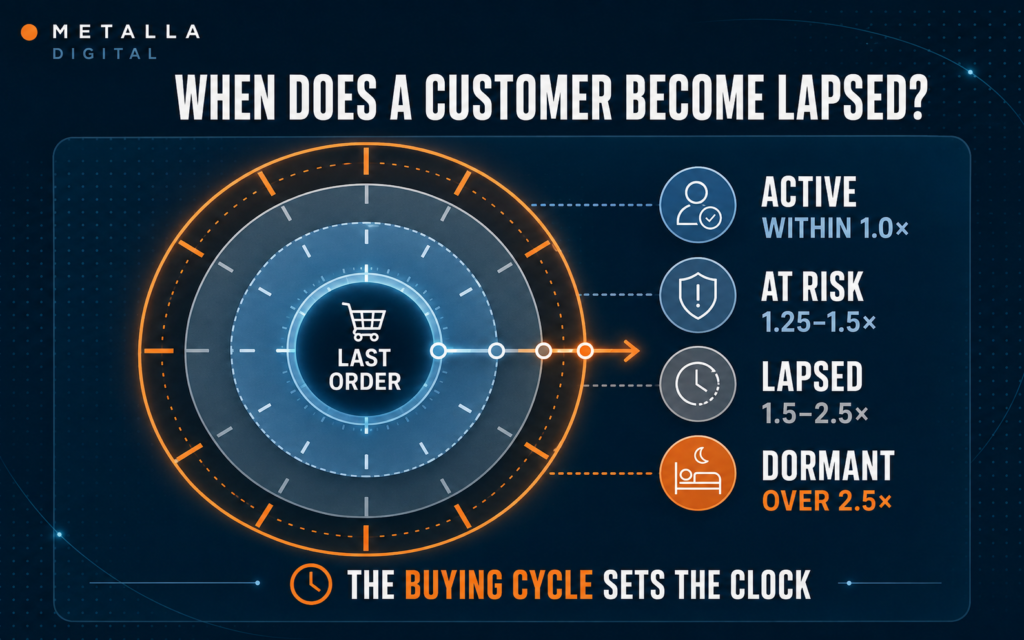
Use the following bands as a starting point, then adjust them using your own order history:
| Customer stage | Timing against normal repurchase interval | Main objective |
|---|---|---|
| Active | Within 1.0x | Post-purchase support, cross-sell, replenishment |
| At risk | Around 1.25x to 1.5x | Helpful reminder with no discount |
| Lapsed | Around 1.5x to 2.5x | Full win-back sequence |
| Dormant | Beyond 2.5x | Final recovery attempt, then suppression review |
If skincare buyers usually reorder after 60 days, an at-risk message might begin near day 75 and win-back near day 90. A furniture buyer needs a longer window and a cross-sell message.
Klaviyo’s win-back guidance recommends basing the first message on the normal buying cycle. Klaviyo also outlines a practical way to calculate the cycle by exporting customers with at least two purchases and reviewing the time between orders.
Use RFM Segmentation Before Sending a Win-Back Campaign
Recency shows who stopped buying. Frequency and monetary value show who deserves priority.
RFM stands for:
- Recency: How long ago the customer last purchased.
- Frequency: How often the customer has purchased.
- Monetary value: How much the customer spends.
A high-value repeat customer should not receive the same opening offer as a one-time sale buyer. Early access, service, loyalty credit, or a relevant new product might recover the repeat customer. A stronger price incentive only makes sense when the next order still produces enough contribution profit.
Build at least four segments:
| Segment | Suggested definition | Message priority |
| High-value lapsed | Above-median spend or order count, overdue | Personal recognition, service, newness |
| Product-specific lapsed | Overdue based on the last product purchased | Replenishment, upgrade, related product |
| One-time lapsed | One purchase, overdue | Education, proof, then controlled offer |
| Discount-led dormant | First order used a large discount, long overdue | Margin-capped final offer or suppression |
Klaviyo’s RFM analysis report uses purchase recency, frequency, and spending. Smaller stores may build simple versions from order count, total spend, last order date, and purchased product.
The Five-Message Customer Win-Back Strategy
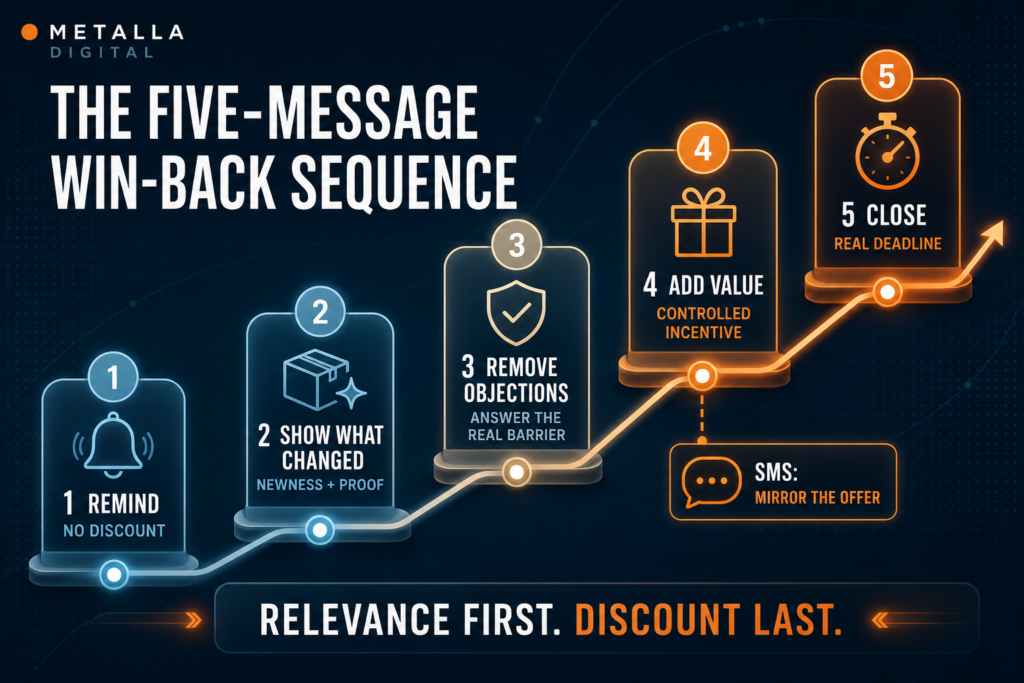
The following sequence gives each message one job. Treat the timing as a baseline and adjust for the purchase cycle.
Email 1: Remind Them Why They Bought
Send the first win-back email campaign when the customer crosses the lapsed threshold. Reference the relationship and original benefit, then recommend the logical next purchase. Do not lead with a discount.
Subject line win-back email examples:
- Still getting the most from your [product]?
- Ready for your next [category] order?
- A quick update since your last order
Lead the customer to a relevant category or personalized recommendation, not the homepage.
Email 2: Show What Changed
Send email two three to five days later.
Feature a new product, improved formula, recent best seller, stronger reviews, or a customer story. Replace “We miss you” with what has improved for the buyer.
Email 3: Remove the Main Buying Objection
Send email three four to six days later.
Use behavioural data and customer research. Address fit, shipping, product use, or another known objection. Ask one direct question: “What stopped you from ordering again?” A short survey might reveal product, price, or experience problems no email sequence will fix.
Email 4: Introduce a Controlled Incentive
Start with added value before cutting price. Free shipping, a gift, bonus points, a sample, or a threshold offer often protects more margin. A high-value buyer might receive a gift. A one-time buyer might receive “Spend $100, save $15.”
If the customer has SMS consent, mirror this offer through one short text. SMS should shorten the path to checkout. It should not repeat every paragraph from the email.
Email 5: Close the Sequence
Use a real deadline, restate the strongest benefit, and give one clear action. If no purchase or meaningful engagement follows, move the profile toward a sunset segment.
Klaviyo recommends a sunset process for long-term inactive profiles because repeated sends to unmonitored inboxes harm deliverability. Its sunset flow guide explains the relationship between final recovery attempts and suppression.

How Much Should You Discount in a Win-Back Campaign?
The wrong question is, “Which discount gets the most orders?”
Ask, “Which offer produces the most incremental contribution profit?”
Calculate the contribution available before selecting the incentive:
Contribution before incentive = revenue - product cost - fulfilment - payment fees - shipping subsidy - variable service costs
Assume a $100 order has $35 in product cost, $8 in fulfilment, $3 in payment fees, and a $10 shipping subsidy. The order produces $44 before the win-back incentive. A 20% discount reduces the available contribution to $24 before email, SMS, returns, or support costs.
This does not make the discount wrong. It shows the real trade-off.
Use an offer ladder:
- No discount. Lead with relevance, education, or newness.
- Added value. Test free shipping, gifts, samples, or points.
- Threshold offer. Require enough spend to protect order economics.
- Percentage or fixed discount. Reserve the deepest offer for a defined segment with a hard expiry.
Never reward customers for learning to wait. If every win-back flow ends with 25% off, regular buyers soon understand the pattern.
How to Build a Win-Back Flow in Klaviyo
Klaviyo supports a metric-triggered win-back flow based on Placed Order:
- Use Placed Order as the trigger and add a delay based on the buying cycle.
- Add “Placed Order zero times since starting this flow.”
- Split by order count, value, product, or RFM group.
- Add email and optional SMS steps.
- Exclude recent buyers, unsubscribed profiles, suppressed profiles, and conflicting flows.
- Test links, discounts, dynamic products, mobile layout, and exit logic.
Once a customer orders, they should leave the recovery sequence. Stores with separate product cycles should build category-specific branches or flows. Klaviyo notes its predicted next order date does not account for the specific product last ordered.
For a wider view of the tools supporting retention, analytics, reviews, and conversion, see my Shopify tech stack guide.
How to Measure True Customer Reactivation
Do not judge a win-back campaign by open rate. Opens help diagnose subject lines and deliverability, but the business goal is profitable customer reactivation.
A customer win-back strategy deserves credit only for purchases created by the program.
Track these metrics:
- Reactivation rate: Lapsed customers who purchased divided by delivered recipients.
- Revenue per recipient: Win-back revenue divided by delivered recipients.
- Contribution profit per recipient: Win-back contribution profit divided by delivered recipients.
- Second-order rate: Reactivated customers who purchase again within the next expected cycle.
- Unsubscribe, spam complaint, and bounce rates: Signals of list quality.
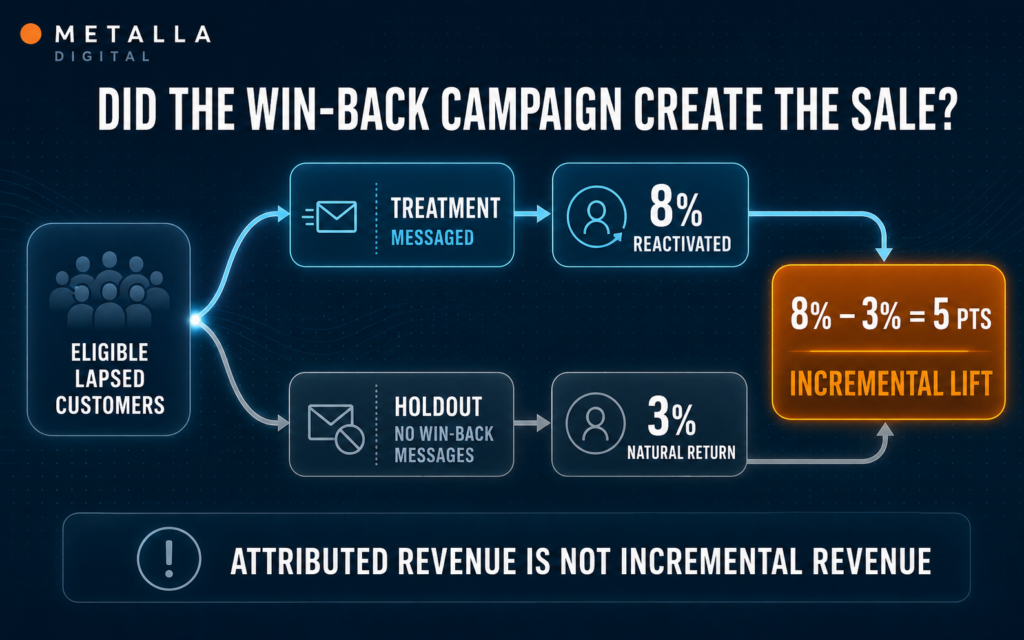
Then isolate incrementality with a holdout group.
Incremental reactivation rate = treatment reactivation rate - holdout reactivation rate
Incremental revenue = incremental reactivation rate x eligible customers x average reactivated order value
If 8% of the messaged group buys and 3% of the holdout group buys, the sequence produced an estimated five percentage points of incremental reactivation. Giving the campaign credit for the full 8% overstates performance.
Klaviyo offers global holdout groups for eligible accounts with at least 400,000 profiles. Smaller brands may create a stable random control segment outside the flow, provided the split stays consistent and receives no win-back messages during the test.
Common Customer Win-Back Mistakes
- Sending too early: The customer has not lapsed yet, so the offer gives away margin on a purchase already likely to happen.
- Using one delay for every product: Different categories follow different purchase cycles.
- Discounting in the first email: A reminder buyer receives money they never asked for.
- Ignoring purchase history: Generic recommendations waste the strongest first-party data in the account.
- Measuring attributed revenue only: Natural repeat purchases inflate the reported result.
- Forgetting flow exits: Recent buyers keep receiving “come back” messages after purchasing.
- Mailing dormant or unprofitable buyers forever: List quality declines while refunds, chargebacks, or support costs erase profit.
Customer Win-Back FAQs
What is the difference between win-back and re-engagement?
Win-back targets previous customers who stopped buying. Re-engagement targets subscribers who stopped opening or clicking, including non-buyers. The audience, message, offer, and success metric should differ.
How many emails should a win-back flow include?
Start with four or five emails over roughly three to four weeks. Give every email a separate purpose. Stop after the final attempt and review inactive profiles for suppression.
Should the first win-back email include a discount?
No. Start with a relevant reminder, new product, education, or personalized recommendation. Introduce an incentive only after value-led messages fail.
What is a good customer reactivation rate?
No universal rate applies across product categories, purchase cycles, list quality, and lapse definitions. Establish your baseline, use a holdout group, and optimize for incremental contribution profit instead of chasing a borrowed benchmark.
When should ecommerce brands run win-back campaigns before BFCM?
Launch early enough for the full sequence to finish before peak promotional volume begins. For a three-to-four-week flow, September or early October gives recovered customers time to re-enter active segments before November.
Build Win-Back Around Profit, Not Reported Revenue
A customer win-back strategy should recover profitable customers without training the entire list to wait for a discount.
Start with the buying cycle. Segment customers using RFM and product history. Lead with relevance. Escalate offers only when the economics support them. Remove buyers after purchase and suppress long-term inactive profiles after the final attempt.
Most important, measure incremental contribution profit. Reported revenue tells you who purchased after receiving a message. A holdout tells you how many purchases the program created.
If your paid acquisition looks healthy while profit stays flat, review the full system: CAC, conversion rate, AOV, repeat purchase rate, contribution margin, and payback period. Book an intro call with Metalla Digital to find where your ecommerce growth model is losing value.