Your Meta dashboard reports a 4.0 ROAS. Shopify shows a smaller lift in total revenue. Email ran during the same week, branded search increased, and returning customers placed many of the orders.
So, how much revenue did Meta create?
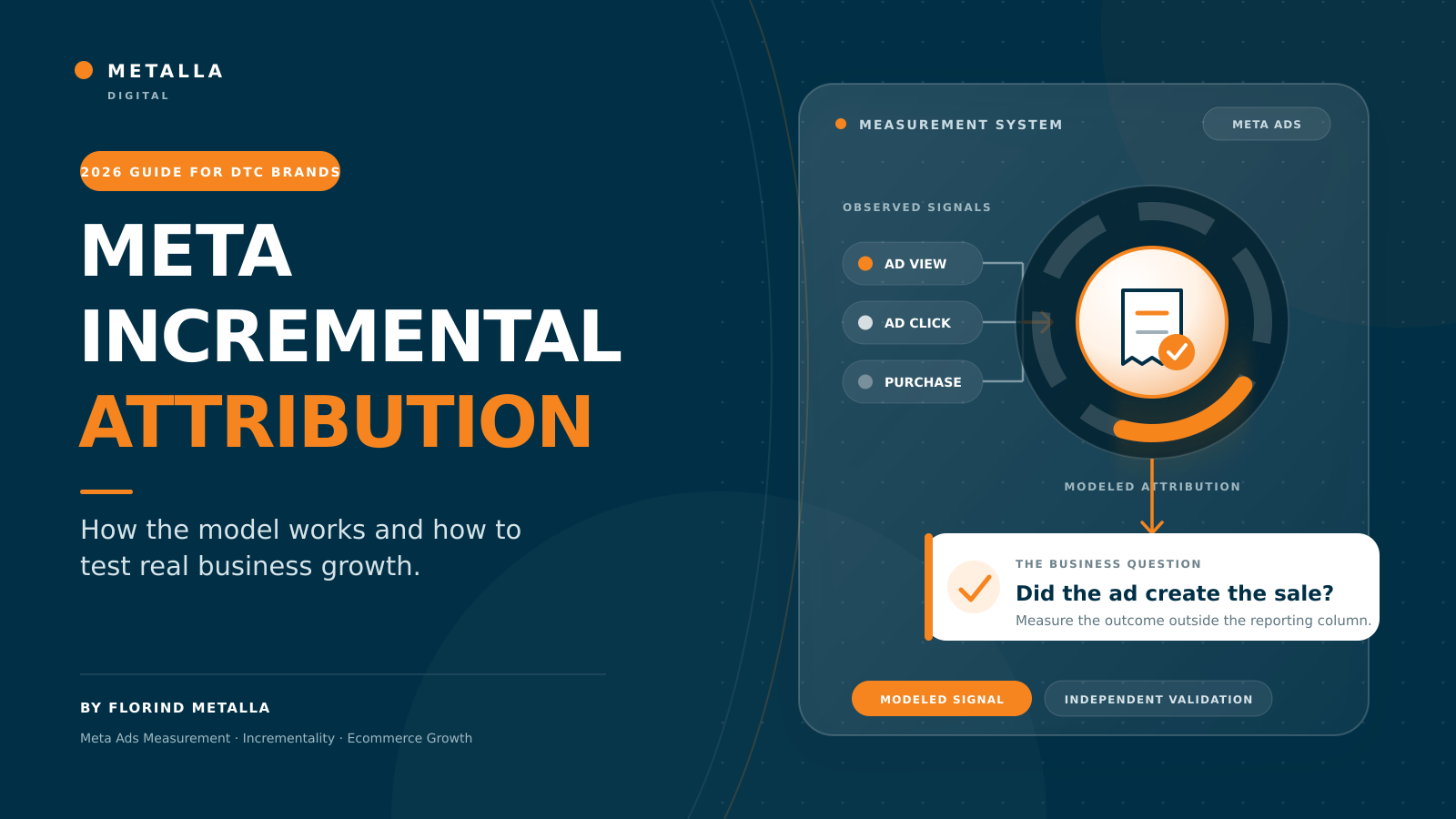
Standard attribution does not answer this question. Standard attribution shows whether a purchase happened after an eligible ad click or view. A customer who planned to buy before seeing an ad still appears as an attributed conversion when the purchase falls inside Meta’s selected window.
Meta incremental attribution aims to separate sales influenced by ads from sales likely to happen without them. This changes both reporting and, when selected as an optimization goal, ad delivery.
For ecommerce brands, the difference matters. A campaign should earn budget by generating additional revenue, new customers, or contribution margin.
TL;DR
- Standard attribution gives Meta credit when a conversion follows an eligible click, view, or engaged view.
- Incremental attribution uses Meta’s machine learning models to predict which conversions resulted from ad exposure.
- Incremental reporting compares modeled credit without changing delivery. Incremental optimization changes the conversion Meta seeks through the auction.
- A lower incremental ROAS does not mean campaign performance fell. The model assigned less credit.
- Validate major budget decisions with Shopify, CRM, and finance data. Meta does not publicly explain the model’s training data, calibration process, or account-level error rate.
Table of Contents
What Is Meta Incremental Attribution?
Meta describes incremental attribution as an attribution model designed to optimize ad delivery for incremental conversions. Meta’s machine learning models predict whether an ad caused a conversion.
The key word is “predict.”
Meta observes ad delivery, customer signals, and conversion events. The system estimates which outcomes were more likely due to advertising. Purchases likely to happen without an ad receive less credit.
Here is a simple ecommerce example.
A returning customer receives a promotional email, sees a retargeting ad, visits the website directly, and orders. Under standard 1-day view attribution, Meta might receive credit because an impression happened before purchase. Incremental attribution asks whether the ad increased purchase likelihood.
No platform observes both outcomes for the same person. Meta uses modeled estimates to address this missing comparison.
Meta Incremental Attribution vs Standard Attribution
Both models influence how Meta reports results. The selected model at the ad set level also influences delivery.
| Area | Standard attribution | Incremental attribution |
|---|---|---|
| Main question | Did a conversion follow an eligible ad interaction? | Did ad exposure increase the chance of conversion? |
| Method | Click, view, and engaged-view rules within selected windows | Machine learning prediction |
| Default focus | Conversion volume inside the attribution window | Conversions predicted to result from ads |
| User controls | Click and view windows | Model controls stay inside Meta |
| Expected reporting | More credited conversions | Often fewer credited conversions |
| Best use | Operational reporting and journey analysis | Testing delivery toward additional business outcomes |
Standard attribution still shows customer interaction before purchase. The mistake starts when a team treats sequence as proof of causation.

Read my full Meta Ads attribution guide for a breakdown of click-through, view-through, and engaged-view attribution.
Reporting and Optimization Are Two Different Uses
Meta offers incremental attribution in two places. Each one serves a different purpose.
1. Compare incremental reporting
Open the Columns menu in Ads Manager and select Compare Attribution Models or Compare Attribution Settings. Add incremental results beside your standard results.
This view changes reporting only. Your campaign keeps its existing optimization model.
Start here. The comparison exposes campaigns with a large gap between standard and incremental credit. Review retargeting closely when standard ROAS looks strong while incremental ROAS looks weak.
2. Optimize for incremental conversions
During ad set setup, open the additional options under Performance Goal and select Incremental Attribution when available. Meta then seeks conversions its model predicts advertising caused.
This selection changes delivery. Meta might reach a different audience mix and select different creative winners.
Do not judge this setting by comparing two columns on the same campaign. Once delivery changes, you need a controlled test based on store outcomes.
How to Turn On Meta Incremental Attribution
For a new ecommerce campaign:
- Open Meta Ads Manager and select Create.
- Choose the Sales objective.
- Set your conversion location, dataset, and Purchase event at the ad set level.
- Find Performance Goal and open See More Options.
- Select Incremental Attribution.
- Complete your audience, placements, budget, and creative setup.
- Publish the campaign and avoid unnecessary edits during the test.
For reporting on an existing campaign, open Columns, select Compare Attribution Models or Compare Attribution Settings, then add Incremental Attribution under the advanced options. Review purchases, value, CPA, and ROAS beside standard results.
Interface labels vary across account updates. Availability depends on objective, conversion location, and account eligibility.
Why Incremental ROAS Is Often Lower
Incremental attribution usually gives Meta less credit than standard attribution. Less credited revenue produces a lower reported ROAS when spend stays equal.
Assume a campaign spends $10,000.
- Standard attributed revenue: $40,000
- Standard ROAS: 4.0
- Incremental attributed revenue: $26,000
- Incremental ROAS: 2.6
The 1.4-point gap does not prove Meta overreported revenue. The gap shows two models assigned credit differently.
Business performance did not fall when you added a reporting column. Orders, cash collected, and fulfilment stayed the same.
Many advertisers see the lower number, assume performance broke, and abandon the test. The team still needs to learn whether incremental optimization improves store performance.
What Meta Has Confirmed and What Meta Has Left Unclear
Meta confirms three important points in its public documentation:
- Machine learning models predict whether ads caused conversions.
- Incremental attribution supports reporting and delivery optimization.
- Incremental results are modeled.
Meta has not published the model architecture, training data, calibration process, or typical account-level error range.
Meta’s public documentation also does not state an account-level holdout starts when an advertiser selects incremental attribution. Some online guides describe an automatic control group, but those descriptions often mix incremental attribution with Meta Conversion Lift, a separate measurement product based on randomized test and holdout groups.
Incremental attribution produces a modeled estimate. Conversion Lift produces an experimental estimate across treated and untreated groups.
Meta’s model asks a better business question than a basic window. Better alignment does not guarantee perfect measurement. Validate performance outside Meta.

A Practical Test Plan for Ecommerce Brands
Do not replace every campaign at once. Run a structured test with a decision attached.
Step 1: Fix tracking before testing attribution
Verify Purchase fires only after a completed order. Confirm Pixel and Conversions API events share an event ID for deduplication. Check revenue values, currency, refunds, and test orders.
Duplicate or missing purchase data will produce weak conclusions. Use my Meta Ads troubleshooting guide to review tracking first.
Step 2: Choose one business outcome
Pick the metric tied to your decision. Good options include:
- Net revenue after discounts and refunds
- New customer orders
- New customer revenue
- Blended customer acquisition cost
- First-order contribution margin
- Total contribution margin
- Marketing efficiency ratio
Do not make incremental ROAS your only success metric. Your primary outcome should come from Shopify, your CRM, or finance records.
Step 3: Build a fair comparison
Compare both models through Meta’s A/B testing tools when available. Another option uses matched geographic markets with similar revenue history and seasonality.
Keep these inputs consistent:
- Conversion event
- Budget
- Bid strategy
- Audience eligibility
- Placements
- Creative supply
- Offer
- Landing pages
- Test dates
Do not compare June with July. Promotions, inventory, email volume, and creative fatigue introduce too many differences.
Step 4: Give delivery enough time
Set the test length before launch. Three to four weeks offers a practical starting point, but purchase volume and revenue volatility should set the final duration.
Avoid daily edits. Frequent budget, audience, or creative changes make the result harder to interpret. Your Meta campaign structure should stay simple enough for each test cell to gather meaningful purchase data.
Step 5: Read the business result first
At the end of the test, compare the external outcomes selected in Step 2.
If incremental optimization reports lower ROAS while producing more new customer revenue or contribution margin, the test delivered a better business result.
If Meta reports stronger incremental performance while total store revenue, new customer volume, and margin stay flat, you do not have enough evidence to scale.
Where Incremental Attribution Adds the Most Value
Test incremental attribution when several demand sources compete for credit.
Strong use cases include:
- A large returning-customer base
- Heavy email and SMS activity
- High branded search volume
- Retargeting campaigns with strong reported ROAS
- Frequent product launches or promotions
- A meaningful mix of direct and organic sales
- Enough purchase volume for a controlled comparison
The setting also supports fairer prospecting evaluation. A cold customer often represents a clearer growth opportunity than a loyal customer preparing to reorder.
Incremental attribution does not equal new-customer attribution. An existing customer’s purchase still represents incremental revenue when ads created the purchase. Track buyer status separately.
Delay testing when your account has broken tracking, low purchase volume, unstable budgets, inventory problems, or constant offer changes. Incremental optimization will not rescue weak creative. Strong creative strategy still determines who responds and why.
Common Meta Incremental Attribution Mistakes
Treating modeled conversions as verified truth
Meta estimates causation without publishing an account-level accuracy score. Use the result as one decision input.
Assuming lower ROAS means worse performance
A reporting change often lowers credited revenue without changing store revenue.
Confusing incremental conversions with new customers
Incrementality measures additional outcomes. New-customer reporting measures buyer status.
Comparing different time periods
Month-over-month tests mix attribution changes with seasonality, promotions, and demand.
Scaling from Ads Manager alone
Review net revenue, contribution margin, blended CAC, and cash flow before increasing spend.
Should You Use Meta Incremental Attribution?
Established ecommerce brands should test incremental attribution without treating the setting as an independent source of truth.
Start with reporting. Find campaigns where standard and incremental results disagree. Then run a controlled delivery test using a metric from Shopify or finance.
The goal is not to produce the highest ROAS inside Ads Manager. The goal is to buy more revenue and profit your business would not receive without advertising.
If Ads Manager, Shopify, and finance tell three different stories, book an intro call with METALLA. We help DTC brands spending over $25,000 per month reduce wasted ad spend, improve customer acquisition, and scale around real business outcomes.
Frequently Asked Questions
What is Meta incremental attribution?
Meta incremental attribution uses machine learning to predict which conversions happened because of ad exposure. Standard attribution credits conversions following eligible clicks or views within selected windows.
Does Meta incremental attribution lower ROAS?
Incremental ROAS often appears lower because the model gives Meta less conversion credit. A lower reported number does not mean store revenue fell.
Is incremental attribution the same as Conversion Lift?
No. Incremental attribution provides modeled reporting and optimization. Conversion Lift uses randomized test and holdout groups to estimate average lift during a defined experiment.
Does incremental attribution measure new customers?
No. Incrementality and new-customer status answer different questions. Use Shopify or CRM data to track first-time buyers separately.
How long should an incremental attribution test run?
Three to four weeks provides a useful starting point for established DTC accounts. Historical purchase volume, revenue volatility, and the minimum business improvement worth detecting should determine final test length.
Should Shopify brands use Meta incremental attribution?
Shopify brands with clean tracking, stable spend, and enough purchase volume should test the setting. Measure net revenue, new customer revenue, blended CAC, and contribution margin outside Ads Manager.
Where do I find incremental attribution in Meta Ads Manager?
For delivery optimization, look under Performance Goal and open See More Options at the ad set level. For reporting, use the Columns menu and select Compare Attribution Models or Compare Attribution Settings.
Does Meta run a holdout when I select incremental attribution?
Meta’s public documentation does not say an account-level holdout starts with this setting. Meta documents Conversion Lift separately as its randomized holdout product.