Last updated: August 7, 2026
Meta Ads Manager reports 50 purchases. Shopify reports 38 orders. GA4 gives Meta credit for 27 purchases. Which number should guide your next budget decision?
Each platform answers a different question.
Meta Ads attribution models decide which conversions receive credit inside Meta, which results appear in Ads Manager, and which signals guide ad delivery. Shopify records store orders. GA4 distributes credit across measurable digital touchpoints. None of those views proves how many sales happened because of advertising.
Meta also changed its attribution system in March 2026. Link clicks now sit apart from social engagement. Engage-through attribution replaced the old engaged-view structure. A five-second video view now qualifies as engagement, down from 10 seconds. Any article built around Meta’s old “any click” rule now gives advertisers the wrong explanation.
This guide explains the current Meta attribution model, the available attribution settings, and a practical measurement system for DTC brands.
Meta Ads Attribution in 60 Seconds
Conversions API improves event transmission and matching. Conversions API does not prove causality.
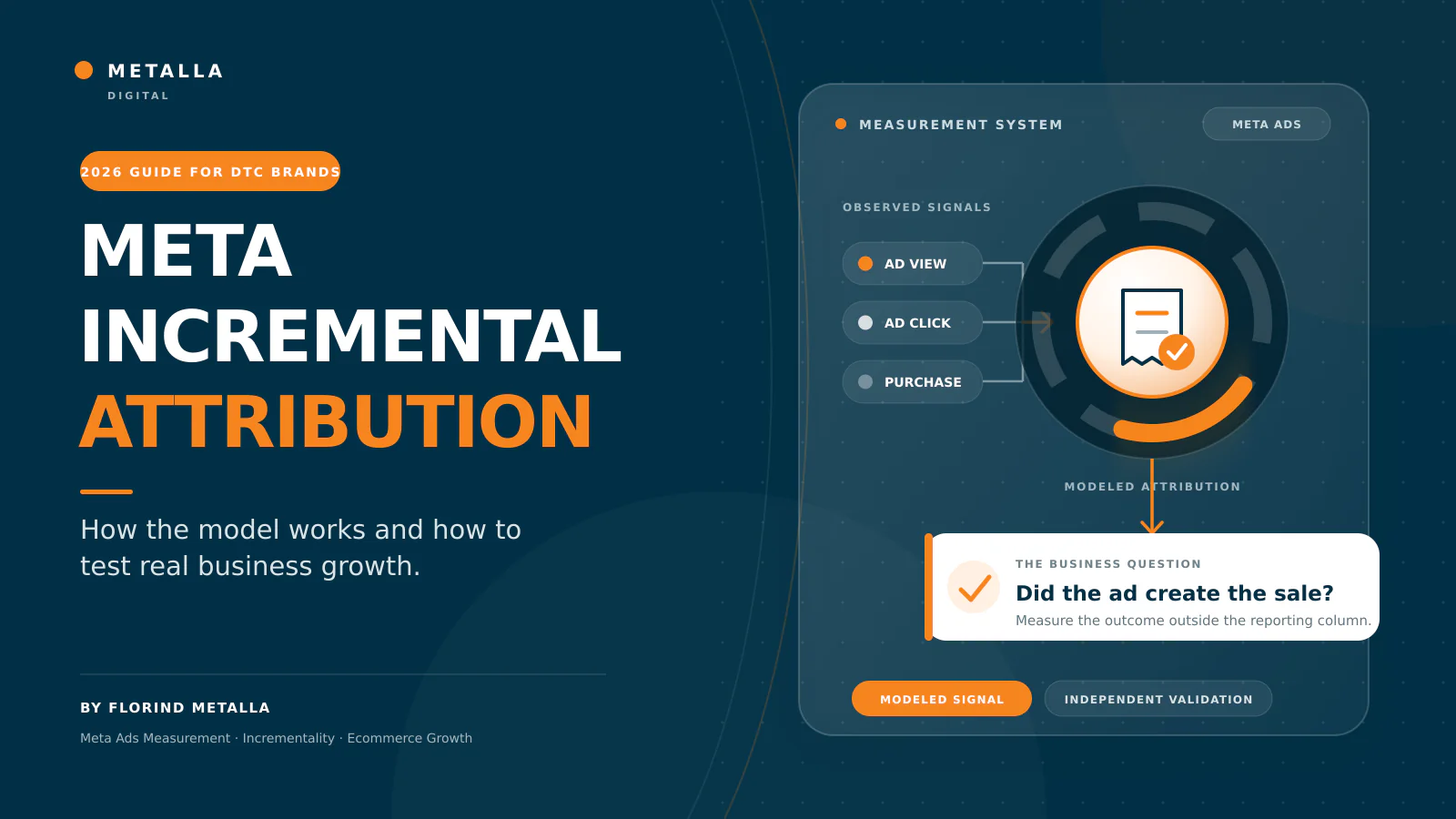
Meta offers two attribution models: Standard and Incremental.
Standard attribution credits conversions after eligible ad interactions within selected time windows.
Incremental attribution predicts which conversions happened because of ad exposure.
Current standard settings include 1-day or 7-day click-through, 1-day engage-through, and none or 1-day view-through for eligible campaigns.
Meta’s attribution setting affects reporting and delivery. A setting change alters the success signals used by the ad system.
Ads Manager should guide campaign delivery. Shopify, CRM, and finance data should guide business decisions.
First Conversion does not mean first-time customer. The setting counts the first selected event after an eligible ad interaction.

Table of Contents
What Is Meta Ads Attribution?
Meta Ads attribution assigns credit for a conversion to a Facebook or Instagram ad after an eligible interaction. The interaction and conversion must fall within the selected attribution window.
Consider three customer journeys:
- A shopper clicks a product link on Monday and purchases on Thursday. A 7-day click setting makes the purchase eligible for Meta credit.
- A shopper saves a carousel ad and purchases later the same day without opening the product link. A 1-day engage-through setting makes the purchase eligible.
- A shopper receives an ad impression, takes no recorded action, and purchases later that day. A 1-day view-through setting makes the purchase eligible.
Eligible does not mean caused.
Standard attribution shows a sequence. An ad interaction happened, then a conversion happened within the chosen window. Incrementality asks a harder question: would the conversion have happened without the ad?
The difference between sequence and causation sits at the centre of every Meta attribution decision.
Meta’s attribution setting also affects optimization. Meta trains delivery around the conversions counted under the chosen setting. A broad setting supplies more conversion signals. A narrow setting supplies fewer signals with a more direct relationship to the ad.
This tradeoff explains why the setting with the cleanest reporting does not always produce the strongest delivery. Your measurement system should separate platform optimization from business truth.

What Changed in Meta Ads Attribution in 2026?
Meta announced a major attribution update on March 3, 2026. The update reorganized ad interactions into clearer categories and corrected a long-standing reporting issue.
1. Click-through now requires a link click
Before the update, Meta treated many ad interactions as clicks. A reaction, comment, share, save, profile tap, or copy expansion might place a later conversion inside the click-through bucket.
Meta now reserves click-through attribution for link clicks. The person must click a link that opens the advertiser’s website, app, lead form, messaging destination, or another linked destination.
This change gives Meta click-through reporting a closer relationship to the traffic recorded by analytics platforms. Differences still exist, though the old “any click” explanation no longer reflects current Meta attribution logic.
Source: Meta, Simplifying Ad Measurement for a Social-First World
2. Engage-through now covers social interactions
Engage-through attribution counts a conversion after a qualifying non-link interaction with an ad. Qualifying actions include reactions, comments, shares, saves, carousel interactions, and eligible video views.
The engage-through conversion window lasts one day.
Meta moved social actions out of click-through reporting so advertisers see a clearer difference between destination traffic and on-platform engagement.
Source: Meta, Set Up Engage-through in Meta Ads Manager
3. Five seconds now qualifies as an engaged video view
The former engaged-view definition required at least 10 seconds of video watch time, or 97% of a shorter video. Meta lowered the watch threshold to five seconds while retaining the 97% rule for videos shorter than five seconds.
This new threshold reflects short-form viewing behaviour across Reels, Stories, and Feed. The measurement remains an engagement signal, not proof of a sale caused by the video.
4. Standard and Incremental now form the two model choices
Standard attribution remains the common reporting and delivery model. Incremental attribution gives advertisers an alternative based on predicted causal impact.
The distinction matters more than any single window. A 7-day click under Standard still measures eligible post-click conversions. Incremental attribution estimates which conversions the ads generated beyond the expected baseline.
How Meta Ads Attribution Models and Settings Work
Advertisers often use “model,” “setting,” and “window” as if all three mean the same thing. Meta treats them as separate controls.
| Layer | Available choices | What the layer controls |
|---|---|---|
| Attribution model | Standard or Incremental | Whether Meta credits eligible conversions after an interaction or predicts ad-caused conversions |
| Interaction type | Click-through, engage-through, view-through | Which ad action makes a later conversion eligible |
| Attribution window | 1-day click, 7-day click, 1-day engage, none or 1-day view | How long the interaction stays eligible for credit |
| Conversion count | All Conversions or First Conversion | Whether reporting includes every eligible event or only the first selected event |
This separation leads to four questions before any campaign change:
- Do you want Standard or Incremental optimization?
- Which user actions deserve credit?
- How long does the buying decision take?
- Do you need every eligible conversion or the first selected conversion?
An advertiser who changes only the window without answering those questions risks solving the wrong problem.
Standard vs Incremental Attribution
Standard attribution
Standard attribution counts conversions connected to eligible ad interactions within selected time windows. The model helps Meta find more people likely to complete the chosen event under the same rules.
Standard attribution works well for:
- New accounts still building conversion volume
- Creative and offer testing
- Campaigns with short, observable customer journeys
- Daily delivery decisions inside Ads Manager
- Advertisers who need control over click, engage, and view windows
The main limitation involves causality. Standard attribution gives an ad credit when a qualified interaction precedes a conversion. The model does not establish whether the ad created the demand.
A branded search, an email, an influencer post, or pre-existing customer intent might drive the same purchase. Meta still receives credit when the purchase meets the selected rules.
Incremental attribution
Incremental attribution uses machine learning models trained with data from Meta lift experiments. The model predicts which conversions would not have happened without the ads, then optimizes delivery toward people with a higher predicted incremental response.
Incremental attribution works well for:
- Established campaigns with stable conversion volume
- Brands with strong organic demand
- Accounts where retargeting reports unusually high ROAS
- Budget allocation between prospecting and warm demand
- Advertisers focused on net-new customers and net-new revenue
Meta reported that its Q4 2025 model rollout drove 24% more incremental conversions than its standard attribution model. Treat the figure as Meta’s aggregate platform result, not a forecast for your account.
Source: Meta, 2026: AI Drives Performance
Incremental results often look lower than Standard results because the model discounts conversions with a high chance of happening without the ad. A lower reported ROAS does not signal weaker business performance. The number measures a stricter outcome.
Read the dedicated Meta Incremental Attribution guide for setup, testing, and interpretation.
Standard and Incremental answer different questions
| Question | Standard | Incremental |
| Did a conversion follow an eligible ad interaction? | Yes | No |
| Did the ad likely cause an additional conversion? | No | Yes, based on Meta’s prediction |
| Does the advertiser control interaction windows? | Yes | Limited by the incremental model |
| Best use | Delivery, testing, daily optimization | Growth measurement and causal optimization |
| Main risk | Over-crediting existing demand | Lower signal volume and model dependence |
Click, Engage, and View Attribution
Click-through attribution
Click-through counts a conversion within one or seven days after a link click. The 2026 definition excludes reactions, comments, shares, saves, and other non-link actions.
A link click shows direct intent to leave Meta or open a selected destination. For performance campaigns, click-through conversions provide the strongest observable connection between the ad and the site visit.
Click-through still does not prove causation. A shopper might already know the brand or return through another channel before purchase. The link click gives stronger evidence than a passive impression, though business data still needs to validate the outcome.
Engage-through attribution
Engage-through counts a conversion within one day after a qualifying non-link interaction. The category includes social engagement and an eligible video view of at least five seconds, or 97% of a shorter video.
Engage-through helps advertisers measure customer journeys where a person engages inside Facebook or Instagram, then purchases through direct traffic, search, or another route.
The signal carries less purchase intent than a link click. Use the metric to understand creative influence and social response. Avoid treating every engage-through purchase as equal to a destination click.
View-through attribution
View-through counts a conversion within one day after an impression when no stronger eligible interaction receives credit. The customer does not need to click or engage.
View-through gives Meta visibility into impression-led paths that GA4 rarely observes. The same feature creates the highest risk of over-crediting existing demand, especially for:
- Retargeting audiences
- Existing customers
- High-frequency campaigns
- Large brands with strong direct and organic traffic
- Promotional periods supported by email, SMS, influencers, or retail activity
Treat view-through as supporting evidence. Compare view-inclusive and click-focused reporting before scaling spend.

How Meta Attribution Windows Work
An attribution window defines how long an ad interaction remains eligible for conversion credit.
Current Meta documentation lists these standard options for eligible campaigns:
- Click-through: 1-day or 7-day
- Engage-through: 1-day
- View-through: None or 1-day
Source: Meta, About Attribution Models and Attribution Settings
1-day click
Choose a 1-day click window when the expected action happens soon after the click. Common examples include low-friction lead forms, free downloads, low-priced impulse purchases, and landing pages built for an immediate response.
The benefit comes from a tighter relationship between the click and conversion. The cost comes from missed credit for shoppers who need more time.
7-day click
Choose a 7-day click window when buyers compare products, discuss the purchase, wait for payday, return from another device, or complete the purchase after several sessions.
The wider window reflects a longer sales cycle and supplies Meta with more conversion signals. The same wider window raises the chance of another channel influencing the final decision.
1-day engage-through
Choose 1-day engage-through when social interaction and short-form video play a meaningful role in the customer journey. The setting fits products where people save, share, comment, or research after watching.
Judge engage-through separately from link-driven conversions. A social action shows attention, not the same level of intent as a destination visit.
1-day view-through
Choose 1-day view-through when impression-led influence matters and the account has enough business data to challenge Meta’s claim. Review the share of results lost after removing view-through from reporting.
Avoid using view-inclusive ROAS as the only scaling metric for retargeting, customer campaigns, or high-frequency promotions.
Best Meta Attribution Settings by Campaign Type
No universal setting fits every account. Start with the expected decision speed, then use Compare Attribution Settings to test the assumption.
| Campaign type | Starting point | Reporting check | Main risk |
| Low-AOV impulse purchase | 1-day click, test 1-day engage | Compare against 7-day click | Missing delayed purchases |
| Most DTC prospecting | 7-day click, 1-day engage | Review click-only and view-inclusive results side by side | Giving too much weight to passive views |
| High-AOV ecommerce | 7-day click, 1-day engage | Validate against order data and conversion lag | Cutting ads before the buying cycle finishes |
| Free lead magnet | 1-day click | Match leads to CRM source and quality | Crediting delayed leads influenced elsewhere |
| High-ticket lead generation | 7-day click | Track qualified leads, sales, and revenue in CRM | Optimizing for cheap form fills |
| Retargeting | 1-day or 7-day click | Remove view-through from the primary KPI and test incrementality | Claiming customers who planned to buy anyway |
| Existing customer campaign | Click-focused reporting | Compare first and all conversions with customer status in Shopify or CRM | Counting repeat demand as acquisition |
The table provides starting points, not fixed rules. A $40 replenishment product and a $40 novelty product share an AOV while having different buying cycles. Use your measured conversion lag, new customer rate, and contribution margin before changing delivery.
At Metalla Digital, we separate the window used for Meta delivery from the reporting view used for budget decisions. Meta receives enough signal to learn, while click-focused, first-party, and profit data decide whether higher spend makes sense.
How to Compare Attribution Settings
Meta’s Compare Attribution Settings report shows how results change under different interaction rules without changing the live ad set.
Step 1: Open the comparison
In Ads Manager, select Columns, then Compare Attribution Settings. Choose the available click-through, engage-through, view-through, Standard, Incremental, First Conversion, and All Conversions options relevant to the campaign.
Source: Meta, Compare Attribution Settings in Meta Ads Manager
Step 2: Use a stable date range
Review at least one full buying cycle. A seven-day view of a product with a three-week purchase cycle gives an incomplete result. Avoid periods with tracking changes, site outages, major offer changes, or inventory gaps.
Step 3: Build a nested comparison
Assume Standard attribution reports 100 purchases:
| Reporting view | Purchases | What the difference suggests |
| 7-day click + 1-day engage + 1-day view | 100 | Full standard result |
| 7-day click + 1-day engage | 84 | 16 purchases rely on view-through eligibility |
| 7-day click only | 70 | 14 more purchases rely on engage-through eligibility |
| 1-day click only | 52 | 18 click-driven purchases happened after day one |
This example does not label one view as correct. The comparison shows where Meta finds the credit.

Step 4: Compare campaign types separately
Prospecting and retargeting should not share one attribution conclusion. A high view-through share in broad prospecting means something different from the same share inside an existing-customer audience.
Compare:
- Prospecting vs retargeting
- New customers vs returning customers
- Static vs video creative
- Evergreen vs promotional campaigns
- Low-AOV vs high-AOV products
- First Conversion vs All Conversions
Step 5: Check the business result
Pair the Meta comparison with:
- Shopify orders and net sales
- New customer revenue
- GA4 paid social paths
- CRM qualified leads and closed sales
- Refunds, cancellations, and chargebacks
- Contribution margin
- Blended marketing efficiency ratio
Do not change a strong live campaign after one attribution comparison. Record the gap, form a hypothesis, and test one change while the rest of the account stays stable.
Why Meta, GA4, and Shopify Never Match
Meta, GA4, Shopify, and your CRM measure different parts of the same customer journey.
| Source | Primary question | Strength | Limitation |
| Meta Ads Manager | Which ads should receive credit and delivery priority? | Ad-level delivery signals, cross-device identity, click, engage, and view paths | Meta judges its own contribution |
| GA4 | Which measurable touchpoints receive cross-channel credit? | Website behaviour and channel paths | Limited visibility into Meta impressions and on-platform engagement |
| Shopify | How many orders and how much store revenue occurred? | Transaction record | Does not establish the source or causal driver by itself |
| CRM | Which leads became qualified opportunities and customers? | Lead quality, sales status, and offline revenue | Depends on source discipline and sales-team updates |
| Finance data | Did the business gain profitable revenue? | Net revenue, refunds, margin, and cash impact | Less useful for ad-level delivery decisions |
| Lift testing | How many extra conversions did advertising create? | Causal measurement | Requires test design, volume, time, and clean execution |
Different touchpoints receive credit
Meta observes link clicks, on-platform engagement, impressions, and logged-in cross-device behaviour. GA4 focuses on measurable website or app interactions and applies its own attribution model. Shopify records the order regardless of which channel claims credit.
Different windows apply
Meta might use a 7-day click window. GA4 uses a configurable key-event lookback window and a separate reporting model. A purchase might qualify under one platform and fall outside the other platform’s rules.
Google documents data-driven, paid and organic last click, and Google paid channels last click as current GA4 attribution options.
Source: Google Analytics, Get Started With Attribution
Cross-device identity differs
A shopper might click on Instagram from a phone and purchase from a laptop. Meta might connect both actions through a logged-in identity and matched event data. GA4 might record two users or lose the earlier source after consent and cookie limits.
Modeled and observed events differ
Both Meta and Google use modeling in parts of their measurement systems. Each platform has a different data set, identity graph, consent environment, and objective. Equal totals should not serve as the goal.
Counting rules differ
Meta’s All Conversions setting might count repeat purchases after one ad interaction. Shopify records both orders. GA4 distributes channel credit under the selected model. A CRM might treat both purchases as one customer.
The right process does not force every source to match. Your team should understand each gap, watch whether the gap changes, and anchor scale decisions to profitable business growth.
If your reported Meta performance looks strong while store revenue stalls, use the Meta Ads Not Working guide and the 15-point Facebook Ads audit to check tracking, structure, creative, and the post-click journey.
First Conversion vs All Conversions

Meta lets advertisers compare First Conversion and All Conversions for a selected event.
All Conversions

All Conversions includes every eligible occurrence of the selected event inside the attribution window. If a customer clicks an ad and places three orders within seven days, all three purchases might appear under All Conversions.
First Conversion
First Conversion includes the first selected event after the eligible interaction. In the same example, Meta reports the first purchase and excludes the next two purchases from that comparison column.
First Conversion does not mean new customer
This distinction matters. A returning customer who places the first purchase after an ad click still counts under First Conversion. Meta does not turn that person into a first-time buyer.
Use Shopify or CRM customer status to measure new customer acquisition. Use Meta First Conversion to reduce repeat-event inflation inside the chosen window.
First Conversion helps answer:
- Does one ad interaction lead to repeated events?
- Does a campaign look stronger because existing customers purchase often?
- Does the gap between Meta and backend order counts come from repeated actions?
- Does prospecting drive more first events than retargeting?
Conversions API and Attribution Accuracy
Meta Conversions API sends event data from a server, website platform, app, CRM, or offline source to Meta. CAPI supports measurement and delivery when browser tracking loses signals through cookie limits, consent choices, network issues, or ad blockers.
Source: Meta, About Conversions API
CAPI improves the event data available to Meta. CAPI does not decide whether an ad caused the sale.
Use Pixel and CAPI together
Many ecommerce setups send the same purchase from the browser and server. Meta needs matching deduplication keys to keep one event and discard the duplicate.
Send matching event names and event IDs for the browser and server versions of the same event. Also verify:
- Event time
- Order ID
- Value
- Currency
- Action source
- Customer information parameters sent with proper hashing and consent

Source: Meta, About Deduplication for Meta Pixel and Conversions API Events
Audit event quality before attribution strategy
Before testing a new attribution model, confirm:
- Purchase fires once per order.
- Browser and server events deduplicate.
- Value and currency match Shopify.
- Test orders appear in Events Manager.
- UTMs persist from ad click to checkout.
- Ad account, Shopify, GA4, and reporting time zones align.
- Refunds and cancellations appear in the business reporting layer.
An attribution test built on duplicate purchases or missing values produces a clean-looking wrong answer.
The Metalla DTC Attribution Framework
After more than $11 million in managed ad spend, one measurement rule has stayed consistent: no single platform should decide whether your business grew.
Use four layers.
Layer 1: Delivery data
Use Meta Ads Manager for daily campaign decisions:
- Spend
- Reach and frequency
- Link click-through rate
- Landing page views
- Cost per purchase or lead
- Purchase conversion value
- Attribution-setting comparisons
Meta sees ad-level delivery signals faster than Shopify, GA4, or finance reports.
Layer 2: Transaction and customer data
Use Shopify and CRM data for weekly quality checks:
- Orders
- Net sales
- New customer revenue
- Returning customer revenue
- Qualified lead rate
- Closed revenue
- Refund and cancellation rate
This layer reveals whether Meta finds valuable customers instead of cheap events.
Layer 3: Profit data
Use finance data for monthly scale decisions:
- Gross margin
- Contribution margin
- Shipping cost
- Merchant fees
- Discounts
- Blended customer acquisition cost
- Marketing efficiency ratio
- Incremental revenue from added spend
- Marginal ROAS
A campaign with lower platform ROAS might create more profitable new revenue than a retargeting campaign with a higher reported ROAS.
Layer 4: Incrementality
Use incremental attribution, Conversion Lift, geo tests, or holdouts for major budget decisions:
- Did higher spend create more total sales?
- Did prospecting reach buyers outside existing demand?
- Did retargeting add conversions or claim them?
- Did the campaign improve new customer acquisition?
- Did the extra revenue cover variable costs and added spend?
Meta describes Conversion Lift as a test of the incremental effect of ads through randomized exposed and unexposed groups.
Source: Meta, About Conversion Lift

Frequently Asked Questions
What is a Meta attribution model?
A Meta attribution model decides how Facebook and Instagram ads receive conversion credit. Meta currently offers Standard attribution, which counts eligible conversions within selected interaction windows, and Incremental attribution, which predicts conversions caused by ad exposure.
What is the default Meta Ads attribution setting in 2026?
Eligible web conversion campaigns often open with Standard attribution using 7-day click-through, 1-day engage-through, and 1-day view-through. Available settings vary by objective, conversion location, account, and campaign setup. Check the ad set instead of assuming every campaign uses the same default.
What is the best attribution setting for Facebook Ads?
The best setting matches the buying cycle and conversion volume. Start with 1-day click for immediate actions, 7-day click for considered purchases, and treat engage-through or view-through as separate influence signals. Validate the choice with Compare Attribution Settings, Shopify, CRM, and profit data.
What is the difference between Standard and Incremental attribution?
Standard attribution credits conversions after eligible clicks, engagements, or views within selected windows. Incremental attribution predicts which conversions happened because of the ads and would not have happened otherwise.
What is engage-through attribution on Meta?
Engage-through credits a conversion within one day after a qualifying non-link interaction. Examples include reactions, comments, shares, saves, carousel actions, and video views lasting at least five seconds or 97% of a shorter video.
Does Meta still use 28-day click attribution?
Meta’s current standard Ads Manager documentation lists 1-day and 7-day click-through options for eligible campaigns. Separate Meta reporting surfaces follow different rules. Commerce Manager, for example, documents its own 28-day click-through and 1-day view-through window. Confirm the reporting surface before comparing results.
Why does Meta report more conversions than GA4?
Meta observes link clicks, on-platform engagement, view-through paths, matched events, and cross-device activity under Meta’s rules. GA4 applies a separate attribution model to measurable web and app touchpoints. Different windows, identity methods, and credit rules produce different totals.
Does Conversions API fix Meta attribution?
Conversions API improves event transmission, matching, and measurement. Proper deduplication also prevents Pixel and server events from counting twice. CAPI does not prove whether ads caused a conversion.
Does changing attribution settings affect ad performance?
Yes. Meta optimizes delivery around the conversions counted under the selected attribution setting. A narrower setting supplies fewer, more direct signals. A broader setting supplies more signals with a weaker causal relationship. Test changes instead of editing a strong live ad set without evidence.
Is First Conversion the same as a new customer?
No. First Conversion reports the first selected event after an eligible ad interaction. A returning customer still qualifies. Use Shopify or CRM customer status to measure first-time buyers.
Final Takeaway
Meta Ads attribution should help your team make better decisions, not give one platform control over the definition of growth.
Use Standard attribution for delivery and day-to-day optimization. Use Incremental attribution and lift testing to study causality. Use Compare Attribution Settings to see where Meta finds credit. Use Shopify, CRM, and finance data to decide whether higher spend produced more profitable new revenue.
The strongest Meta attribution strategy does not chase the highest reported ROAS. The strategy finds the measurement view that leads to better budget decisions.
If Meta reports strong performance while your business data tells a different story, Metalla Digital helps DTC brands connect campaign delivery, creative strategy, tracking, and profitable growth.